This Sunday, my friends and I did a “DIY” architectural tour of Cincinnati! We each picked a building in the city to research and present on. Our picks were: Cincinnati and Suburban Telephone Company Building, Taft Museum of Art, Contemporary Art Center, and Hilton Netherland Plaza Hotel (with some bonus info on Dixie Terminal from a stranger on the street who was very in the spirit of our activity).
I couldn’t do the other buildings justice in a write up (I’ll see if I get notes shared with me and OKed to post) but wanted to share my research on the Netherland Plaza as it has a long and very interesting history (and I spent a few hours putting info together already). Forgive my lack of in-article citations (and a few direct sentence lifts) but I do have references listed at the end!
General Information
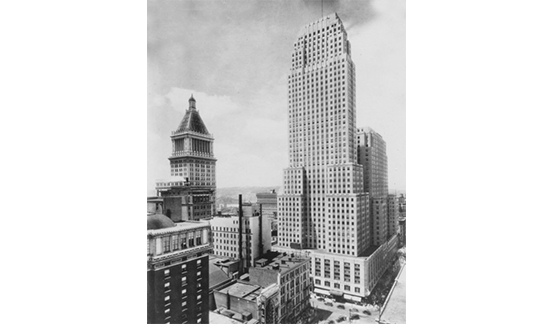
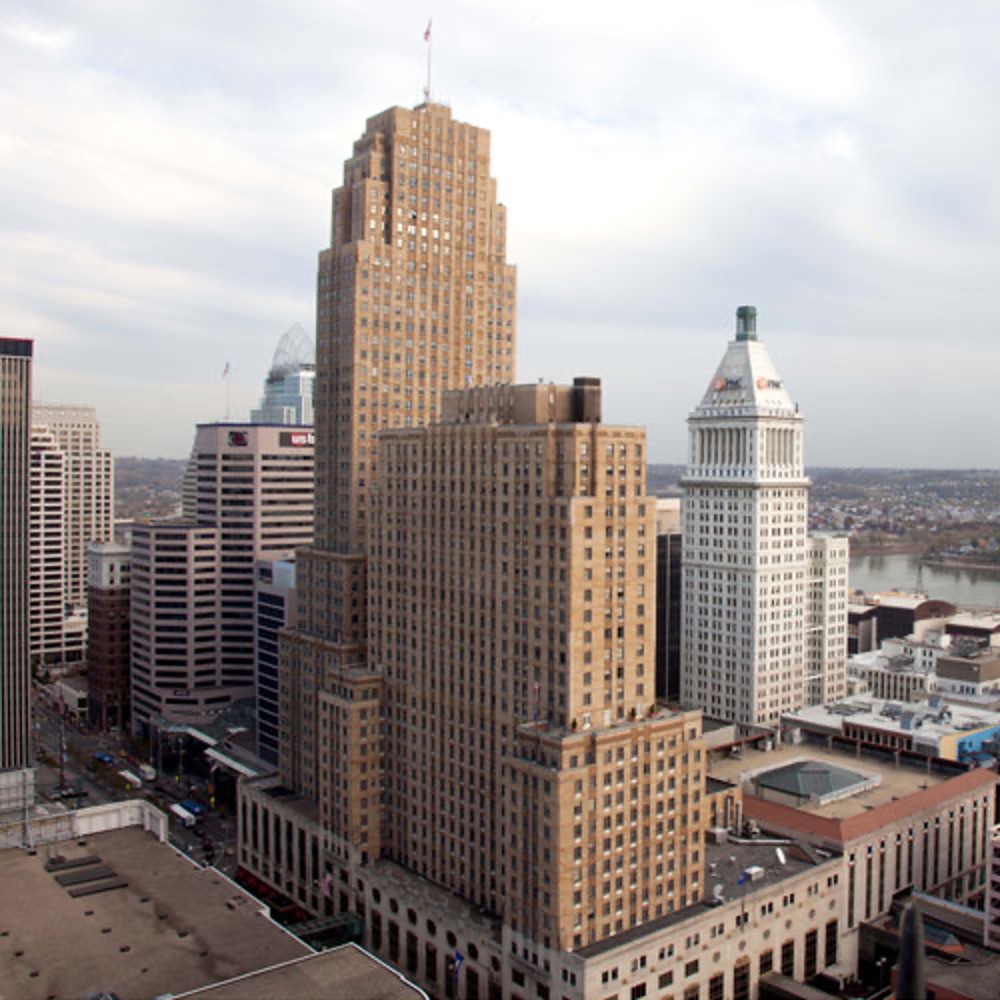
The hotel (originally St. Netherland Plaza) debuted in 1931 as part of a 49-story, 574-foot (175 m) multipurpose commercial structure known as “Carew Tower.” Carew Tower is the second tallest building in Cincinnati (tallest 1931-2010), after the Great American Tower at Queen City Square (i.e. the crown of Cincinnati), which is the third tallest building in Ohio. The Carew Tower replaced the late nineteenth-century Carew Building (home to the Mabley & Carew department store), a nine-story structure built in 1891 in the Romanesque style that was purchased by Thomas Emery following J.T. Carew’s death in 1914.
History: 1929 – 1931
John J. Emery, who purchased the site and funded the new building, hoped the building would function as “city within a city” – with the original idea being that it would include a department store, a theater, an office accommodation, and a hotel to rival the Waldorf-Astoria. John Emery hired Walter Ahlschlager and Colonel William Starrett to begin construction on the hotel. Starett had previously designed the Lincoln Memorial and the Empire State Building, while Ahlschlager had been involved in the design of the Peabody Hotel in Memphis and Hotel Intercontinental in Chicago.
Emery and his partners drew up $33 million (equivalent to over $500 million today) to fund the project; this included Emery liquidating his entire stock portfolio weeks before the 1929 stock market crash.
Emery initially decided to name the hotel the St. Nicholas in reference to a previous luxury hotel that had been the center of Cincinnati social life, but the Cincinnati Realty Company filed an injunction claiming that they had acquired the rights to that name. As the hotel had already monogrammed its linens, china, silverwave, and stationary with the initials “NP,” Emery selected a new name, St. Netherland Plaza, a reference to the location of the hotel in the space between the surrounding hills and the Ohio River as the word “netherlands” literally means low-lying country.
Construction on the hotel began in 1929 and took 13 months (with crews working 24 hours a day and 7 days a week) with the hotel opening in 1931 with a ten-course meal for the 1800 opening night guests in the hotel’s seven restaurants with critics raving that the hotel “challenged the splendor of King Solomon’s Temple.”
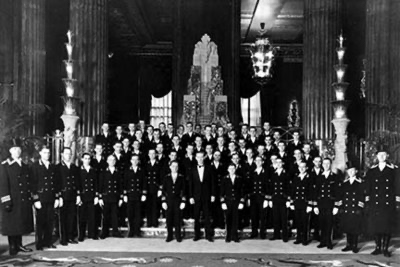
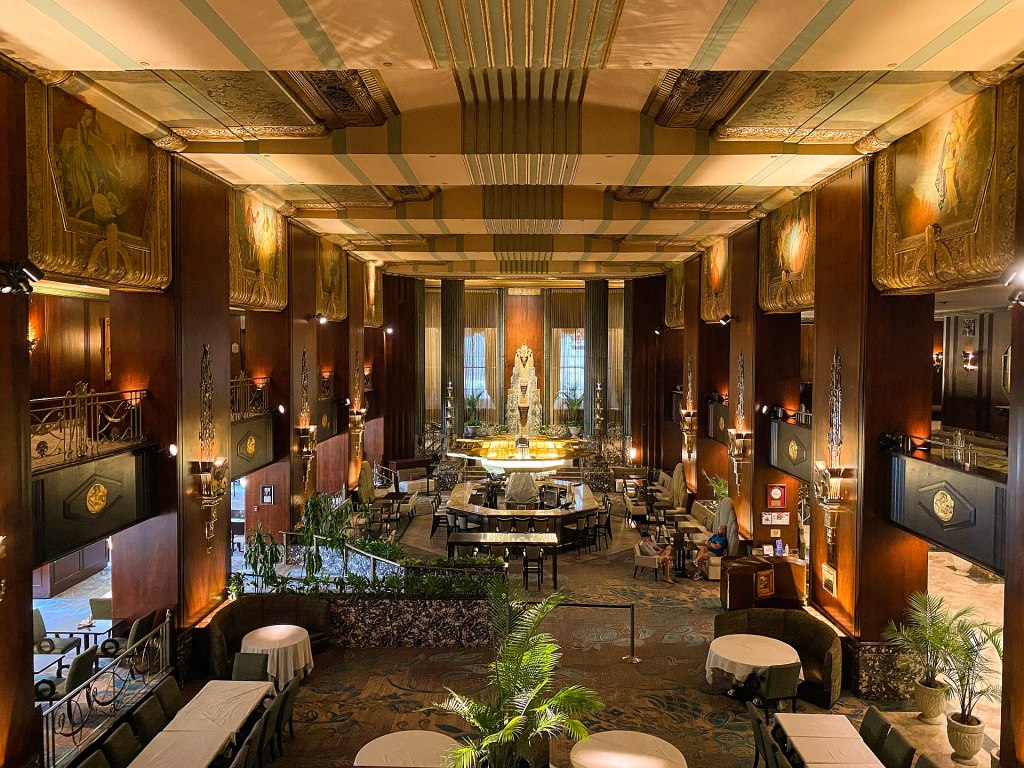
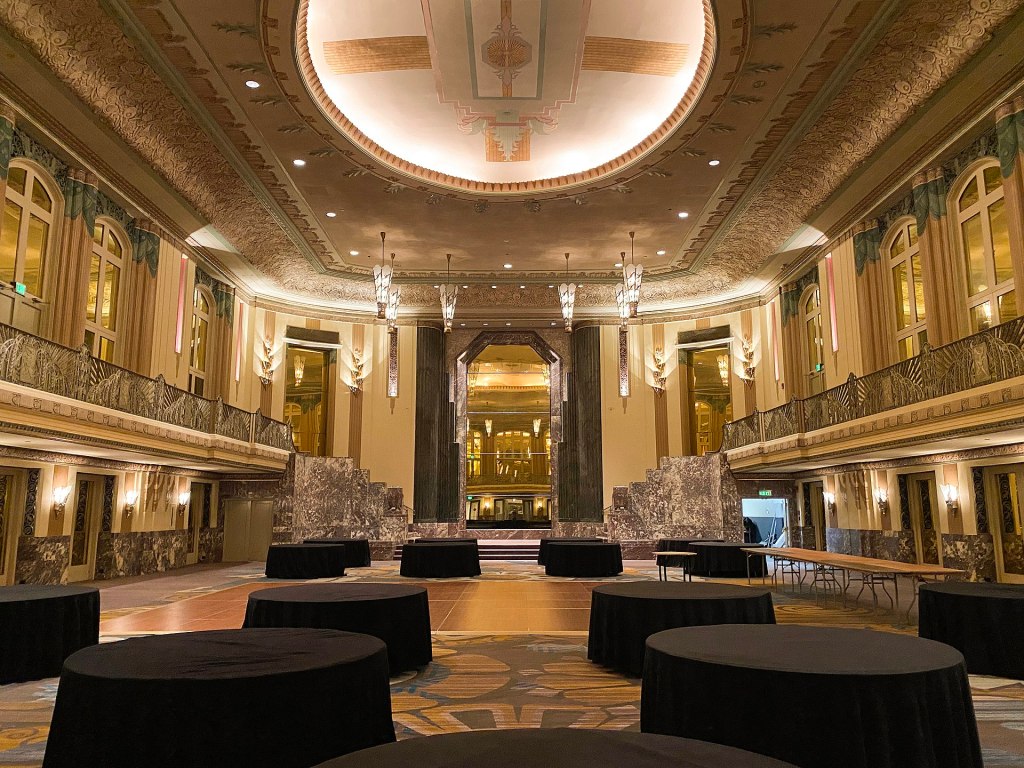
The hotel featured 800 guestrooms with all of the most modern comforts (high-speed automatic elevators, an internal broadcast system, and an automatic electric garage) and Art Deco design elements that utilize rare Brazilian rosewood, marble, custom nickel-silver fixtures, stylized Egyptian and floral motifs, murals, Rookwood Pottery fountain, and Hall of Mirrors (inspired by the Hall of Mirrors at Versailles).
History: 1931 – Present
From 1930 until 1960, the Carew Tower was the home of the Mabley & Carew department store.
Disaster struck in 1942 when a fire and the resulting water damage from the effort to extinguish it destroyed much of the hotel’s interior, including the Hall of Mirrors.
From 1967 to 1980, Carew Tower was featured in the opening and closing credits of the soap opera The Edge of Night (produced by P&G), which used Cincinnati as the stand-in for the fictional location of “Monticello”.
From 1978 to 1982, the building was featured in the opening and closing credits of WKRP in Cincinnati.
The hotel was remodeled in the 1960s to match the modern appearance of many newer hotels and a more significant remodel in the 1980s to bring it to its current state. It took $28 million ($74 million today) to transform the Netherland Plaza back to its glory days. The hotel saw a decline in business in the 1970s and 1980s as business moved away from the center of downtown and travelers opted for hotel chains located near the interstate.
The building was added to the National Register of Historic Places in 1994 (sources conflicted with some noting it as 1985 but 1994 was confirmed by a plaque in the lobby) and was operated by the Omni hotel management company until 2002 when it was acquired by Hilton.
Today, the building is home to a mixed group of tenants, including a shopping arcade, Hilton Cincinnati Netherland Plaza, and offices. Visitors can access the observation deck located on the 49th floor (temporarily closed).
Design
The building is widely considered to be an early prototype of an urban mixed-use development – a “city within a city”. New York City’s Rockefeller Center, built around the same time, is a more famous example of this concept.
The building was originally designed with three towers: the tallest housing offices, the second the hotel, and the third serving as a parking garage which had an elevator rather than traditional ramps for access (demolished in 1980 due to corrosion from road salt).
Art Deco stylistic motifs can be found throughout the building, particularly in the metalwork and areas surrounding the elevators and lights. Sculpture on the exterior and interior of the building were executed by New York City architectural sculptor Rene Paul Chambellan.
Chicago set and theater designer George Unger hired European craftsmen for the elaborate deco design in the interior of the hotel, but at least one Cincinnatian, Rookwood Pottery decorator William Hentschel, left his mark on Netherland Plaza. Hentschel, a New Yorker who started at Rookwood at age 15 and taught at the Art Academy of Cincinnati for 35 years, is credited for creating five front-and-center sculptures in the hotel: two three-foot high, floral and geometric urns flanking the marble steps up to the lobby; two kneeling, web-footed seahorse torch lights flanking the grand staircase in the bar at Palm Court; and the ram’s head fountain behind its stage.
Eighteen Louis Grell murals can be found throughout the Hilton Netherland Plaza Hotel on the bottom floor: 10 wall-to-ceiling murals in the hotel’s original lobby, now the Palm Court; four murals in the Continental Room; two above the side entry staircase. The staircase mural says “Welcome Travelers” and the four in the Continental Room represent the four seasons of the year. The 90-foot long Apollo Gallery includes an “Apollo on Chariot” mural and a large “Hunt of Diana” mural by Grell. These subjects echo similar ones that appear at the Palais de Versailles.
Hauntings
Several accidents occurred over the course of construction, the most notable being a painter that fell to his death while working on the ceiling of the Palm Court. After the hotel opened the painter’s widow checked into a room on one of the upper floors, put on a green formal gown then jumped out of a window and landed firmly in hotel legend as the ghostly Lady in Green. (Other tellings of the story say his body was never found and she’s still searching for it.) Popular sighting spots are the lobby, the overlook, Hall of Mirrors, and the old chapel. She was spotted several times during the 1983 renovations. In more recent years there was a server delivering room service that was sharing an elevator with a pleasant woman in a green dress. Their conversation was going just swimmingly until he turned away for a moment, only to look back and find no one there. The incident left the server so shaken that he took two weeks off to process the implications of his encounter.
In 1956, another tragedy occurred at the hotel. A 25 year old woman named Norma Jean Haller had recently been released from a mental sanatorium. Three weeks earlier she had attempted to kill herself by throwing herself in front of a moving bus, but the bus driver reacted quickly enough to avoid her suicidal attempt. Although the sanatorium felt that she was ready for release, she remained determined to end her life. She went to downtown Cincinnati in order to find a tall enough building to jump from. She found the site of her suicide at the Netherland Plaza Hotel. Instead of taking the elevator, she climbed the stairs to the 28th floor of the building, and she wrote a note on a napkin she had picked up in the lobby. It said, “My name is Jean Haller, call my husband. Children will be better off.” She gently placed the note in the stairwell and climbed out of a window onto a small ledge between the 28th and 29th floors of the hotel. While on the ledge, she wrote another note and placed it on the ledge from which she planned to jump. It read, “please call my husband and tell him I’m sorry.” She jumped at 6:55 PM. She was five months pregnant and left her husband and two children. To this day people will sometimes hear screams and sobbing coming from the stairwell between the 28th and 29th floors.
Employees have also said to hear footsteps in the lobby, even when there is no one there. Perhaps these are the footsteps of a businessman from New York who died unexpectedly of a heart attack in the lobby.
Over the years there have been a slew of other deaths at the hotel. In 1945 author Helen Eustis’ father committed suicide at the hotel by way of gunshot and in 2011 a beloved security guard was stabbed to death on the 6th floor stairwell on his 58th birthday.
Notable Guests
Notable guests of the hotel include:
- Sir Winston Churchill – He loved the bathroom so much he had it copied at his country house at Chartwell. The suite in which he stayed has since been called the Churchill Suite.
- Eleanor Roosevelt (frequent visitor)
- John and Jackie Kennedy, who actually hosted a political gala in the Hall of mirrors in 1959
- Richard Nixon
- George H.W. Bush
- Elvis Presley
- Bing Crosby
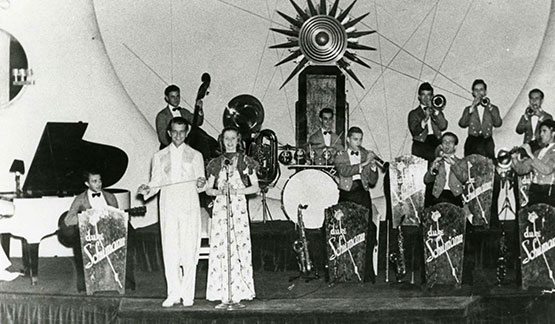
- Doris Day – this Cincinnati native made her professional debut in the hotel’s big band Pavilion Nightclub at age 15 in 1939
References
- Historic Hotels, https://www.historichotels.org/us/hotels-resorts/hilton-cincinnati-netherland-plaza/history.php#:~:text=It%20opened%20under%20the%20name,after%20it%20opened%20in%201931.
- Britannica, https://www.britannica.com/place/Netherlands
- Marshall University et. al. “The Netherland Plaza Hotel .” Clio: Your Guide to History. December 14, 2019. Accessed July 8, 2022. https://theclio.com/entry/13569
- Wikipedia, https://en.wikipedia.org/wiki/Carew_Tower
- Haunted Rooms, https://www.hauntedrooms.com/ohio/cincinnati/haunted-places/haunted-hotels/hilton-netherland-plaza
- Ocoosaws, https://www.ocoosaws.com/me/haunted-travels-usa/hilton-omni-netherland-plaza-hotel-9184.html
- WCPO, https://www.wcpo.com/news/insider/hilton-cincinnati-netherland-plaza-hotel-among-finalists-for-elite-national-award
- Anomalien, https://anomalien.com/real-ghost-stories-of-the-hilton-netherland-plaza-cincinnati/
 Fun-sized: A Travel and Life Blog